Organizing a messy tool chest safely and efficiently involves a systematic five-step process: emptying and cleaning, strategic sorting by type and frequency, implementing internal organization systems like foam inserts, mastering tool placement with heavy items on the bottom, and maintaining order through consistent habits. This approach transforms chaotic storage into a highly functional workspace, enhancing productivity and tool longevity.
The Foundation: Preparing Your Tool Chest for Organization
Before you can build an efficient system, you must clear the slate. The initial step to organizing your tool chest, whether it’s a compact portable box or a large rolling cabinet, is to empty it entirely. This may seem like creating more mess at first, but it is crucial for a thorough overhaul, allowing you to assess every item and clean every nook and cranny.
Begin by laying a clean tarp or a large sheet of cardboard on your workbench or garage floor. Carefully remove every single tool, accessory, and fastener from your tool chest, placing them on this designated area. Once empty, take the opportunity to give your tool chest a deep clean. Wipe down all interior surfaces, including drawer bottoms and dividers, with a damp cloth to remove accumulated dust, grease, grime, and rust flakes. For stubborn stains, a mild degreaser or paint thinner can be effective.
Next, turn your attention to the tools themselves. Inspect each item for dirt, oil, and rust. Clean them thoroughly before storage to prevent corrosion and maintain their longevity. For hand tools, a simple wipe-down is often sufficient, while power tools may require more detailed cleaning with cotton swabs and compressed air for hard-to-reach areas. Crucially, as you clean, assess the condition of each tool. Discard any items that are broken, damaged beyond repair, or unsafe to use, such as screwdrivers with bent tips, hammers with loose heads, or power tools with frayed cords. This decluttering process not only saves space but also eliminates potential hazards and ensures you only keep reliable equipment.
Strategic Sorting: Categorizing Your Tools Effectively
With a clean slate and a collection of functional tools, the next critical phase is strategic sorting. Effective categorization is the backbone of an organized tool chest, allowing for quick retrieval and logical placement. This process helps you understand your inventory and dictates how you’ll assign each tool its permanent home.
Start by grouping your tools according to their type or function. All screwdrivers should go together, all wrenches with wrenches, pliers with pliers, and so on. This logical grouping prevents you from scattering similar tools across different drawers, ensuring you always know where to look. Within these larger categories, further sort tools by size. Arrange wrenches from smallest to largest, for instance, or group small pliers separately from larger ones. This internal order within categories makes it even easier to locate the specific tool you need without rummaging.
Another powerful sorting method is based on frequency of use. Separate your “everyday tools”—those you reach for almost daily, like a tape measure, utility knife, or a basic screwdriver set—from “occasional tools” that are used less frequently, perhaps once a month or for specialized projects. This distinction will inform your drawer layout, placing the most accessible spots for your go-to items. Finally, consider creating a separate pile for specialty tools that are rarely used or are part of a specific kit, such as automotive repair tools or specialized electrical equipment. These might benefit from their own designated storage space, either within a dedicated section of the main chest or in a secondary container.
Choosing the Right Organization Systems for Your Tool Chest
Once your tools are categorized, it’s time to equip your tool chest with internal organization systems that maximize space and protect your investment. The right organizers can transform chaotic drawers into neat, efficient compartments.
- Drawer Liners: Begin by lining all your drawers with protective material. Foam or rubber drawer liners prevent tools from sliding around when you open and close drawers, reducing noise and preventing scratches or damage. These liners also offer a cushioned base, protecting both your tools and the chest’s finish.
- Plastic Trays and Bins: For small parts like screws, nuts, bolts, washers, drill bits, and other fasteners, clear plastic trays or multi-compartment bins are invaluable. These allow you to quickly see the contents without having to open multiple containers, keeping tiny items from getting lost or mixed up. You can find modular sets that fit snugly into your drawers, or repurpose existing clear containers.
- Foam Inserts and Shadow Boards: For a truly custom and professional look, foam inserts are an excellent choice. You can purchase foam sheets and cut out precise outlines for each tool, creating a “shadow board” effect within your drawers. This not only secures tools in place but also immediately highlights if a tool is missing. This method is particularly effective for sets of wrenches, sockets, or screwdrivers, ensuring each piece has its own dedicated slot and remains protected.
- Drawer Dividers: When foam inserts aren’t practical for every drawer, adjustable drawer dividers offer flexibility. You can create custom compartments within a drawer, separating different types of hand tools or preventing larger items from mingling. DIY dividers can be made from sturdy foam scraps or thin pieces of MDF, taped or glued into place.
- Magnetic Strips: For frequently used metal tools like smaller wrenches, screwdrivers, or pliers, magnetic strips can be installed inside drawer lids or along the back of deeper drawers. This keeps tools visible, easily accessible, and prevents them from rolling around.
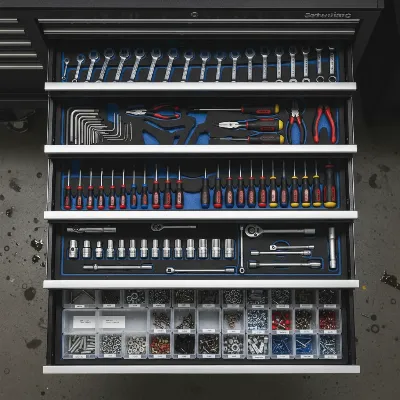 Organized tool chest drawers with foam inserts and labeled compartments
Mastering Tool Placement for Safety and Accessibility
The way you arrange tools within your chest is paramount for both safety and workflow efficiency. Strategic placement minimizes hazards and ensures that the right tool is always within arm’s reach.
A fundamental safety rule for any tool storage is to place heavier and bulkier tools in the lowest drawers of your tool chest. Items such as power drills, impact wrenches, large hammers, and battery packs should reside in the bottom-most, deepest drawers. This practice significantly lowers the center of gravity of your tool chest, enhancing its stability and preventing it from becoming top-heavy and potentially tipping over, which could cause serious injury or damage.
Conversely, your most frequently used tools should be stored in the easily accessible top drawers. Imagine needing your tape measure, a common screwdriver, or a pair of pliers multiple times during a project; having these tools in the uppermost drawers saves you from constantly bending down or searching through lower compartments. Group these essential items logically so you can grab what you need without hesitation.
For sharp objects like utility knives, chisels, saws, or pointed awls, safety dictates they must be stored in sheaths or designated holders. Never leave sharp tools exposed in a drawer where you could accidentally cut yourself when reaching in. If possible, consider storing them in their original cases or in custom foam cutouts that secure the blades and tips. Power tools should also be stored in their original protective cases to shield them from dust, moisture, and impact damage, extending their lifespan. Always remove batteries from power tools before long-term storage to prevent leaks and maintain battery health.
DIY Hacks and Smart Solutions for Budget-Friendly Organization
Organizing your tool chest doesn’t always require expensive store-bought solutions. Many effective and budget-friendly DIY hacks can help you achieve a well-organized system using common household items or inexpensive materials.
One popular and versatile DIY hack involves PVC pipes. Cut sections of PVC pipe to varying lengths and glue them together or to the bottom of a drawer. These can serve as custom holders for drill bits, chisels, small screwdrivers, or even socket extensions, keeping them upright and preventing them from rolling around. For smaller fasteners like nails, screws, and bolts, repurposed clear jars with screw-on lids are excellent. You can even attach the jar lids to the underside of shelves above your workbench, allowing the filled jars to hang securely, freeing up valuable drawer or shelf space while keeping contents visible.
Cardboard or thin MDF scraps can be cut to size and used as custom drawer dividers, creating compartments exactly tailored to your tools. This is a cost-effective alternative to store-bought dividers and can be easily adjusted if your tool collection changes. For very small metal items, like nuts and washers, or even small drill bits, consider placing a magnetic strip along the back or side of a drawer. These strips will hold the items in place, preventing them from scattering every time the drawer opens or closes.
If your tool chest lacks deep drawers for larger items, consider using heavy-duty canvas totes or buckets for specific categories of bulky tools (e.g., gardening tools, car wash supplies, or painting equipment). While these might not fit inside the chest, they can be stored adjacent to it, providing a modular and mobile solution for less frequently used but large items. Remember, the goal is functional organization that suits your needs and budget, proving that creativity can often be as effective as a big purchase.
Maintaining Your Organized Tool Chest: Long-Term Habits
The initial organization of your tool chest is a significant achievement, but the real challenge lies in maintaining that order over time. Consistent habits are key to preventing your tool chest from reverting to its messy past, ensuring long-term efficiency and safety.
The most crucial habit to adopt is cleaning and returning tools to their designated spots immediately after use. It’s tempting to simply toss a tool back into the nearest drawer after finishing a task, but this quick act of disorganization is how clutter begins to accumulate. Take an extra minute to wipe down each tool to remove dirt, grease, or moisture, and then place it back into its specific slot or compartment. This prevents grime buildup, prolongs tool life, and keeps your system intact.
Regularly inspect your tools for signs of wear, damage, or rust. A quick check after each major project or at least once a month can catch issues early. For instance, inspect cutting tools to ensure blades are sharp and guards are intact. For items prone to rust, such as metal hand tools, consider applying a light coating of oil before storage, especially in humid environments. Placing silica gel packs or even a few pieces of chalk in drawers can help absorb excess moisture and prevent rust. Always store torque wrenches at their minimum setting to maintain their calibration accuracy over time.
Periodically, perhaps once every six months or annually, perform a mini-reorganization. This involves a quick sweep of all drawers, re-aligning tools that might have shifted, tidying up small parts, and reassessing if your current layout still serves your needs. As your tool collection grows or your projects change, you might find that certain categories need more space or a different arrangement. This flexibility is essential for an organization system that truly adapts to your DIY journey.
“An organized tool chest is not merely a convenience; it’s a commitment to efficiency, safety, and extending the life of your valuable tools. Treat it as an ongoing process, not a one-time chore.” – Alex “The Fixer” Turner, Master Tradesman & Home Workshop Expert
Conclusion
Transforming a messy tool chest into an organized, efficient, and safe storage solution is one of the most impactful improvements you can make to your home workshop. By following a systematic approach—from the initial decluttering and cleaning to strategic sorting, implementing smart organization systems, and practicing diligent maintenance—you create a workspace that enhances productivity and minimizes hazards. A well-organized tool chest saves you time, protects your investment, and ultimately makes your DIY projects more enjoyable and less stressful. With every tool in its proper place, you’re not just organizing; you’re empowering your passion for creation and repair.
What is one immediate step you can take today to start organizing your tool chest for better efficiency and safety?
Frequently Asked Questions
How often should I organize my tool chest?
|
Our Picks for the Best Tool Chest in 2026
As an Amazon Associate I earn from qualifying purchases.
|
||
| Num | Product | Action |
|---|---|---|
| 1 | Workington Professional Industrial Portable Metal Tool Chest with 6 Drawers, 26" 6-Drawer Tool Chest Cabinet with Ball Bearing Drawer Slides, Steel Tool Storage Box Organizer 4015 Black |

|
| 2 | Keter Stack-n-Roll Modular Tools Organizer for Garage Storage and DIY, 3 Piece Resin Rolling Tool Box System for Small Parts, Black |
|
| 3 | Goplus 5-Drawer Rolling Tool Chest, Tool Storage Box, Removable Tool Cabinet, Sliding Metal Organizer w/Lockable Drawers (Classic Black) |
|
| 4 | Goplus Rolling Tool Chest, 5-Drawer Tool Box Organizer w/Lockable Wheels & Sliding Drawers & Detachable Top & Adjustable Shelf, Tool Storage Cabinet for Garage Workshop(Gray) |
|
| 5 | Goplus Rolling Tool Chest, 5-Drawer Tool Box Organizer w/Lockable Wheels & Sliding Drawers & Detachable Top & Adjustable Shelf, Tool Storage Cabinet for Garage Workshop (Red+Black) |
|
| 6 | IRIS USA Screw Tool Organizer Small Parts Cabinet, 44-Drawer, Electronics Hardware Nuts and Bolts Plastic Storage Drawers Garage Storage, Stackable Bead Craft Organizer Building Bricks Sorter, Black |
|
| 7 | Goplus Rolling Tool Chest, 5-Drawer Tool Box Organizer w/Lockable Wheels & Sliding Drawers & Detachable Top & Adjustable Shelf, Tool Storage Cabinet for Garage Workshop (Blue) |
|
| 8 | Road DAWG ATBT1204D-BLACK Torin Rolling Garage Workshop Tool Organizer: Detachable 4 Drawer Tool Chest with Large Storage Cabinet and Adjustable Shelf, Black |
|
| 9 | Workington Portable Metal Tool Chest with 6 Drawers, 24" 6-Drawer Tool Chest Cabinet with Ball Bearing Drawer Slides, Steel Tool Storage Box Organizer 4005 Black |
|
| 10 | Workington Portable Metal Tool Chest with 9 Drawers, 24" 9-Drawer Tool Chest Cabinet with Ball Bearing Drawer Slides, Steel Tool Storage Box Organizer 4006 Black |
|
Ideally, a comprehensive organization should be done annually, with smaller tidy-ups after each major project. Regular checks and immediate tool returns prevent clutter from building up, saving you from extensive re-organization later.
What are the best ways to prevent rust in a tool chest?
To prevent rust, always clean and thoroughly dry tools before storing them. Use drawer liners, consider adding silica gel packets or a few pieces of chalk to absorb moisture, and apply a light coating of oil to metal tools, especially in humid climates.
How can I make my tool chest safer?
Prioritize safety by placing heavier tools in the bottom drawers to prevent tipping. Store sharp tools in sheaths or dedicated holders to avoid accidental cuts, and regularly inspect all tools for damage before use, discarding any that are unsafe.
What are some inexpensive DIY organization ideas for tools?
Budget-friendly DIY ideas include using cut PVC pipes for drill bits or small tools, repurposing clear jars for small fasteners by screwing their lids under shelves, and creating custom drawer dividers from cardboard or foam scraps. Magnetic strips are also an affordable option for metal tools.
Should I label my tool chest drawers?
Yes, labeling your tool chest drawers is highly recommended. Clear labels provide a quick visual guide, making it effortless to find tools and ensuring they are returned to their correct spots, significantly boosting efficiency, especially for shared workspaces.
Frequently Asked Questions
How often should I organize my tool chest for optimal efficiency?
Ideally, a comprehensive organization should be done annually, with smaller tidy-ups after each major project. Regular checks and immediate tool returns prevent clutter from building up, saving you from extensive re-organization later.
What are the most effective ways to prevent rust in a tool chest?
To prevent rust, always clean and thoroughly dry tools before storing them. Use drawer liners, consider adding silica gel packets or a few pieces of chalk to absorb moisture, and apply a light coating of oil to metal tools, especially in humid climates.
How can I enhance the safety of my tool chest storage?
Prioritize safety by placing heavier tools in the bottom drawers to prevent tipping. Store sharp tools in sheaths or dedicated holders to avoid accidental cuts, and regularly inspect all tools for damage before use, discarding any that are unsafe.
What are some inexpensive DIY organization ideas for tools in a workshop?
Budget-friendly DIY ideas include using cut PVC pipes for drill bits or small tools, repurposing clear jars for small fasteners by screwing their lids under shelves, and creating custom drawer dividers from cardboard or foam scraps. Magnetic strips are also an affordable option for metal tools.
Is it beneficial to label the drawers of my tool chest?
Yes, labeling your tool chest drawers is highly recommended. Clear labels provide a quick visual guide, making it effortless to find tools and ensuring they are returned to their correct spots, significantly boosting efficiency, especially for shared workspaces.
How to Safely Organize Your Messy Tool Chest
Transform your cluttered tool chest into an efficient and safe workspace by following these systematic steps, ensuring every tool is precisely where you need it.
Empty your entire tool chest onto a clean surface. Thoroughly clean all interior surfaces with a damp cloth, and inspect each tool for dirt, oil, or rust, cleaning them before storage. Discard any broken or unsafe tools.
Group tools by type or function (e.g., all wrenches together), then by size within those categories. Separate frequently used tools from occasional and specialty tools to inform drawer layout.
Equip your tool chest with internal organizers. Use drawer liners to prevent sliding, plastic trays for small parts, foam inserts for custom tool outlines, and adjustable dividers for compartments. Magnetic strips can hold smaller metal tools.
Place heavier and bulkier tools in the lowest drawers to enhance stability and prevent tipping. Store most frequently used tools in easily accessible top drawers. Always keep sharp objects in sheaths or designated holders for safety.
Consistently clean and return tools to their designated spots immediately after use. Regularly inspect tools for wear or rust, and perform a mini-reorganization every six to twelve months to adapt to changing needs.
Get our weekly buyer guide
Practical specs, not advice. Unsubscribe anytime.

Mastering tool placement, especially putting heavy items on the bottom, was something I hadn’t really considered beyond basic safety. It makes so much sense for stability and ease of access. My rolling cabinet feels much more balanced now, and I’m not worried about it tipping over when I pull out a heavy impact wrench. Great practical advice!
I tried the foam inserts idea for my smaller drawers, and while it looks neat, cutting them perfectly was a bit of a pain. Maybe I just need more practice. The overall concept of internal organization systems is solid though, and it does keep things from rattling around. Just wish there was an easier way to get those custom fits.
The advice on strategic sorting by type and frequency really resonated with me. I used to just throw things in, but now I’ve got my most-used sockets right at the top. It’s made a noticeable difference in my workflow. I’m still working on the ‘consistent habits’ part, but it’s definitely a step in the right direction for my workshop.
I finally tackled my disaster of a tool chest after reading this. The tip about emptying everything out first was a game-changer. It felt like a huge task, but seeing all my tools laid out helped me really decide what I needed and what was just taking up space. My garage looks so much better now, and I can actually find my wrenches without digging for ten minutes.